
A project-specific GRP grating delivery needs an agreed way to connect each panel to its intended position. The layout drawing shows where it belongs; the panel ID identifies the piece; the packing list tells the receiving team where to find it. These records should refer to the same approved revision.
For a UK project buyer, the practical purchasing question is whether the installer can identify the correct panel without interpreting an unlabelled stack of similar pieces. Agree that identification method before fabrication. A delivery label alone does not confirm that the panel, support arrangement or fixing detail is suitable for service.
What should the layout drawing show before panels are ordered?
The drawing should make the panel positions unambiguous and identify the information still awaiting approval. Ask the supplier and project team to agree which drawing controls the work, who approves it and what changes require another review.
Separate location from specification
A panel reference such as P-014 is an identifier, not a technical specification. Link it to a schedule containing the agreed panel dimensions, product configuration and quantity. Record orientation where the design requires it, especially for pultruded grating. Do not assume that a rectangular outline establishes that direction.
Use the project's agreed units consistently. If the buyer's drawing is in millimetres, keep the panel schedule in millimetres or make any conversion explicit. Do not silently convert or round dimensions in a purchase order.
Make the revision visible
Include the drawing number, revision and approval status in the procurement records. A later drawing may change an opening or panel position without making the change obvious from the panel name. Ask how superseded schedules and labels will be withdrawn when a revision is approved.
How should panel IDs connect to the packing list?
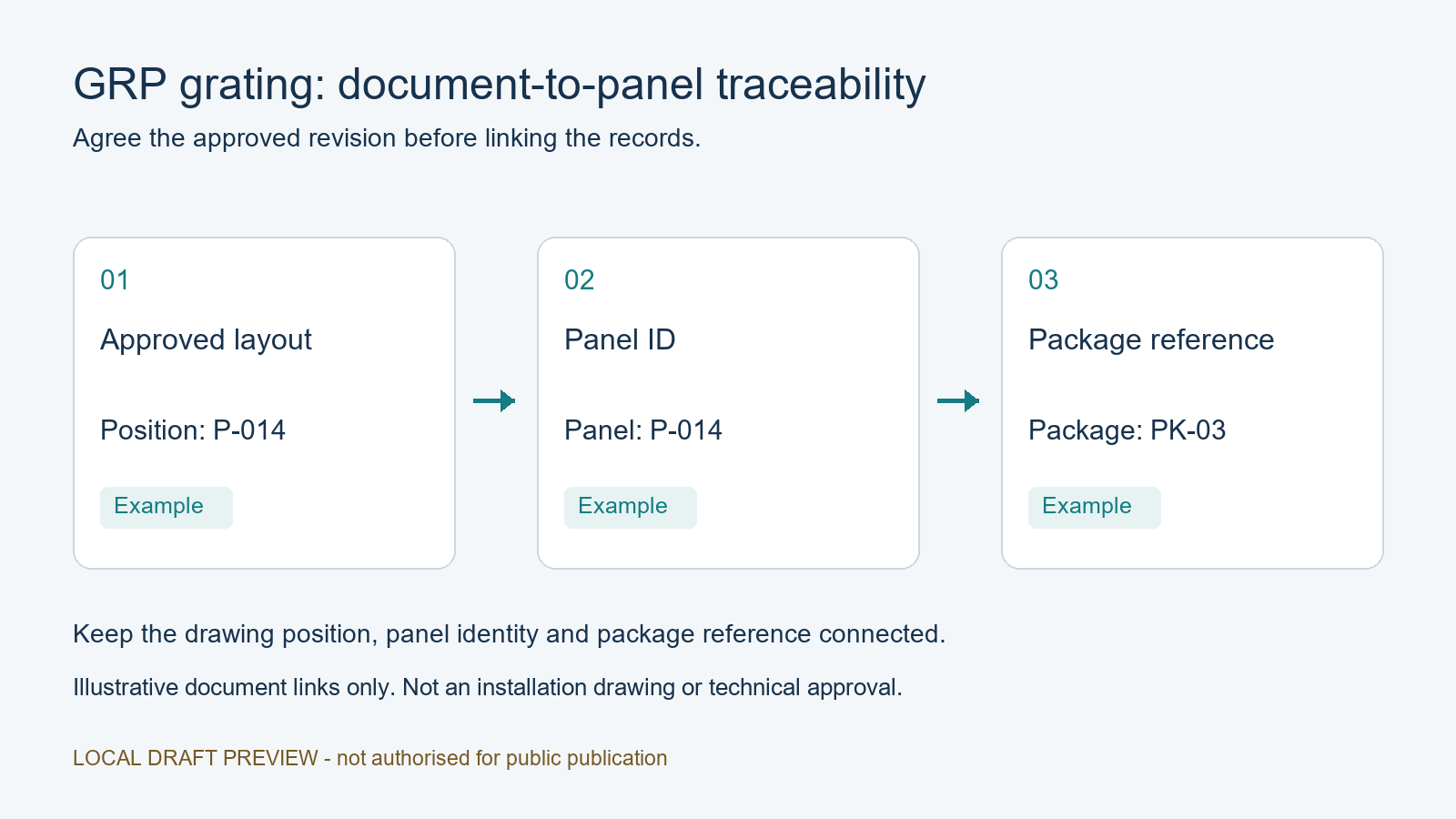
Use one traceable chain: drawing position → panel ID → package reference. The package reference helps the receiving team locate a panel; it should not replace the panel's own identity.
For example, a schedule might associate position P-014 with package PK-03. These are illustrative references, not MACHS shipment records. If several identical panels share a type code, agree whether the project also needs individual position references. Distinguish a repeatable product type from a unique installation location.
Agree how identification will remain readable through the expected handling process, and what record will resolve a missing or damaged label. The buyer should request a sample of the proposed schedule and label format before accepting it as the delivery requirement. Do not specify label durability without considering the actual storage and handling conditions.
What should the receiving team check before releasing panels for installation?
Compare the physical delivery with the agreed documents and record discrepancies before panels are issued to installers. The following is a suggested purchasing checklist, not a substitute for the project's inspection procedure.
| Check | Record to compare | Action if unclear |
|---|---|---|
| Drawing revision | Approved drawing and panel schedule | Ask which revision governs the shipment |
| Panel identity and quantity | Panel labels and packing list | Record missing, duplicate or unreadable references |
| Dimensions and cut-outs | Approved fabrication information | Refer differences for review; avoid improvised alterations |
| Orientation where specified | Panel schedule and installation drawing | Confirm the intended direction before placement |
| Supplied accessories | Agreed accessory schedule | Identify shortages and unresolved fixing details |
| Visible delivery condition | Receiving inspection record | Photograph and report observations using project procedure |
A quantity match is only one check. It cannot resolve a panel with the wrong identity or an unresolved drawing change. Keep identification checks separate from the technical acceptance of loads, supports, cut edges and fixings.
What should a buyer ask MACHS to review at enquiry stage?
Send the current drawing, panel schedule, intended use and known installation constraints. Identify what is approved and what is still provisional. Review the relevant moulded grating product family and fabrication service, then ask MACHS to review the proposed cutting, drilling, sealing, kitting or prefabrication scope against those drawings; drawings and tolerances need confirmation before that scope is agreed.
That review boundary follows the MACHS product knowledge record. It does not imply that every drawing can be manufactured as submitted or that a labelled delivery is an approved structural system. For this procurement task, our editorial recommendation is to agree the document-to-panel traceability before discussing the packing arrangement in isolation.
Gavin Yang's public comment frames specification as a coordinated decision involving material, geometry, fabrication and installation. This supports looking beyond the panel type when planning a purchase. The identification chain proposed here is our editorial application of that broader view, rather than a numbering procedure attributed to him. Read his public comment.
Next step: prepare one marked-up layout and a short list of unresolved panel-identification questions, then send them to MACHS for review.
Frequently asked questions
Can a packing list replace a layout drawing?
For project-specific positions, a list of quantities does not show where each panel belongs. The two records serve different purposes. Agree the position references and connect them to the packing list.
Does a panel ID prove that the panel is safe to install?
No. Identification supports traceability. Suitability still depends on the approved product configuration, supports, loading and installation details.
What if the drawing changes after the panel schedule is issued?
Ask the responsible parties to review the affected panels and agree the revised records before proceeding. Do not assume that relabelling a piece resolves a dimensional or design change.
Related buyer FAQ · Review application conditions · More buying questions
Review evidence · Discuss your requirement
Frequently asked questions
Can a packing list replace a layout drawing?
For project-specific positions, a list of quantities does not show where each panel belongs. The two records serve different purposes. Agree the position references and connect them to the packing list.
Does a panel ID prove that the panel is safe to install?
No. Identification supports traceability. Suitability still depends on the approved product configuration, supports, loading and installation details.
What if the drawing changes after the panel schedule is issued?
Ask the responsible parties to review the affected panels and agree the revised records before proceeding. Do not assume that relabelling a piece resolves a dimensional or design change.