
A composites trade show can put a grating manufacturer, resin producer, equipment builder and test service within the same search results. Those companies may all be relevant to the industry, but they answer different purchasing questions. A promising directory entry is a reason to investigate a role, not proof that the company can supply your finished grating or fabricated profile package.
Build the meeting plan around missing evidence. Before the show, identify the role and the purchasing question. At the booth, resolve the most consequential gap that can realistically be addressed there. Afterward, assign the next review action. This turns a collection of contacts into a traceable screening process without treating attendance, a demonstration or a business card as supplier approval.
What CAMX information is confirmed for planning this review?
As checked on November 17, 2026, the organizer's CAMX FAQ registration section lists the conference for October 18–21, 2027, and the exhibition for October 19–21 at the Anaheim Convention Center. Confirm arrangements again with the organizer before committing to travel or meetings.
Which details should buyers avoid carrying forward from older pages?
The same FAQ includes legacy 2019 and 2020 material, so its older platform and travel answers should not be assumed to describe the 2027 event. The organizer-linked 2027 exhibitor system identifies Anaheim and the event dates, but the page accessible during this review was a preview landing page. We did not verify a complete exhibitor list, exhibitor counts or any particular company's participation.
This article makes no claim that MACHS is exhibiting or that a listed company has a current purchasing requirement. The screening method below is our editorial purchasing approach, not a CAMX qualification service.
Before the show, which supplier role do you actually need to verify?
Start with the output you are trying to buy. Is it finished grating, stock panels, fabricated parts, profiles, raw material or a testing service? Classify each research lead by the role supported by its own product and service information. Leave the role unresolved when the evidence is incomplete.
A resin producer can help explain a material system without being the supplier of a finished access platform. A fabricator may work from purchased panels; a stockist may offer selected variants rather than the entire manufacturer's range. Ask how the proposed supply chain works instead of assuming that every company displaying a finished component manufactures it.
What should go on a meeting card?
Record the company identity, source URL, role being checked and one unresolved question. Add the evidence you already have and the document or explanation needed next. Keep this short enough to use during a conversation. A meeting slot should have a purpose beyond asking someone to repeat a catalog.
How do you prioritize booth conversations without inventing a supplier score?
Separate leads into three working groups: a plausible supply role with a defined evidence gap, a role that still needs clarification, and a role outside the current purchase. These are planning categories, not ratings of competence or a prediction of contract performance.
Give meeting time to gaps that could change the next purchasing decision. For example, establish whether a company can discuss the required finished configuration before spending the appointment reviewing a broad materials presentation. If the gap can be resolved by reading an available document, do that first. Reserve the conversation for the remaining uncertainty.
At the booth, what evidence should you connect to the claim being made?
Ask the representative to identify the product or service behind the statement and the document supporting it. Note the document title, revision and the person who can answer technical questions. A photograph of a display may preserve context, but it does not establish that its construction matches the offered product.
What if the supporting document is not available at the booth?
Record a specific request and its owner: for example, confirmation of the offered configuration and the applicable technical document. Mark the claim as awaiting evidence. Do not fill the gap by borrowing a report from a related product, another manufacturer or an attractive display sample.
Keep commercial interest and technical applicability as separate notes. A representative's willingness to quote does not establish that the product meets a particular U.S. facility's design, fire, slip or other requirements. Those questions need the appropriate product-specific review.
How can the three-stage workflow stay visible after the event?
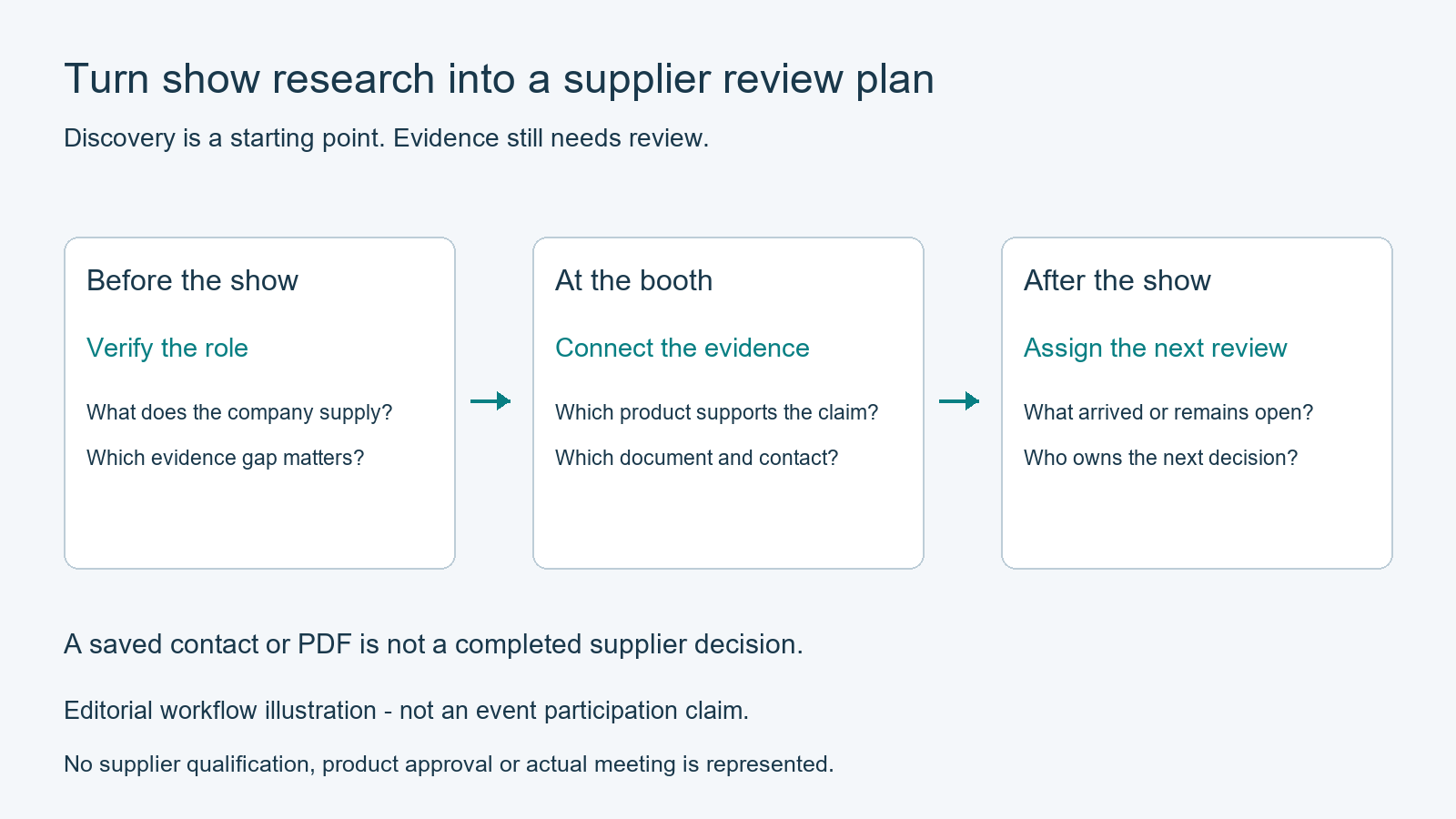
Use the following sequence in the meeting record. The accompanying original diagram illustrates the same information flow; it is not a booth photograph or a statement of event participation.
- Before the show — verify the role. Identify what the company supplies and write the evidence gap that justifies a meeting.
- At the booth — connect the evidence. Link the claim to a product, document reference and accountable technical contact.
- After the show — assign the next review. Record what arrived, what remains unresolved and who owns the next decision.
| Stage | Record to keep | Next action |
|---|---|---|
| Before the show | Role, source and unresolved question | Decide whether a meeting is useful |
| At the booth | Claim, configuration and document reference | Confirm the missing evidence request |
| After the show | Evidence received and remaining gap | Assign review, clarification or closure |
The table is an editorial working format. It does not report an actual MACHS meeting or a completed buyer audit.
After the show, when is a lead ready for technical review?
Compare what was received against the question on the meeting card. If the document identifies the relevant configuration and addresses the gap, route it to the responsible reviewer. If it does not, retain the mismatch and request a targeted clarification rather than labeling the lead qualified.
How do you distinguish follow-up activity from a completed decision?
Use explicit statuses such as evidence requested, evidence received, applicability under review and decision recorded. Assign an owner and an agreed next step. Sending a thank-you message or saving a PDF is activity; it does not close the underlying question. This article recommends a record structure and does not send messages or enroll contacts in a campaign.
What does MACHS contribute to this purchasing approach?
MACHS supplies FRP/GRP grating, profiles and related components. For fabrication to drawings, the discussion needs to connect the material configuration with the parts and scope being requested. Our editorial position is that a useful show conversation should narrow one uncertainty in that connection, rather than produce a general impression of capability.
Founder Gavin Yang's public specification comment emphasizes that product choice must work together with loading, span, resin, surface, mesh, fabrication and installation. This is a paraphrase of his actual comment. Applying it to trade-show research is our editorial extension: organize the meeting around the missing link in the specification. His comment does not endorse CAMX attendance or approve a particular supplier.
What should buyers bring into the next MACHS discussion?
Bring the intended application, configuration information already available and the evidence gap you want to resolve. If you are assessing a fabricated package, include the relevant drawing revision and identify open scope questions. Use the MACHS contact route to discuss that defined need. A focused question gives the next conversation a clearer purpose than an undifferentiated request for a full catalog.
Frequently asked questions
Is an exhibitor entry a verified supplier qualification?
No. It can help discover a company. Its role, offered scope and applicable evidence still need review.
Should a buyer ask every exhibitor for the same document bundle?
Match the request to the role and the decision. A raw-material service and a finished grating supplier may need to answer different questions.
Can a booth demonstration establish suitability for a U.S. installation?
It does not establish suitability by itself. Record the demonstrated conditions and seek the applicable product and project review rather than extending the demonstration beyond its evidence.
Related buyer FAQ · Review application conditions · More buying questions