
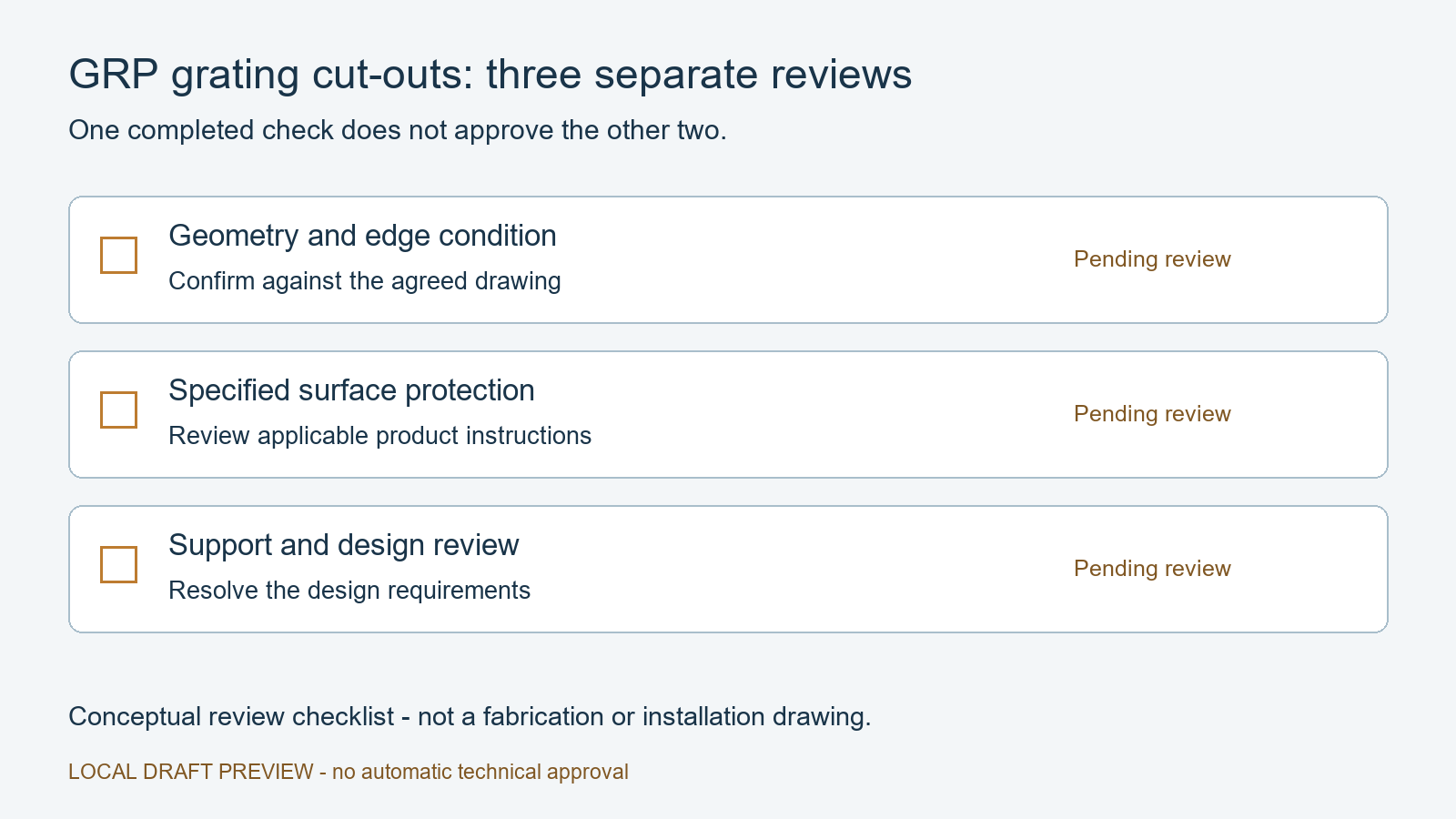
Check the cut-out shape, confirm the specified protection for the newly exposed surfaces, and review whether the altered panel still matches its approved support arrangement. These are separate acceptance questions. A neat edge does not demonstrate that it has been sealed, and a sealed edge does not demonstrate adequate support.
For a UK installation contractor fitting grating around an existing pipe or equipment base, the first step is to identify the supplied grating and obtain the relevant fabrication instructions. This article sets out what to ask and record; it does not prescribe a universal sealant or authorise a site alteration.
Does a smooth cut edge still need a sealing decision?
Yes. Removing rough projections addresses the physical finish. It does not establish the protective treatment required for the exposed composite. Ask the manufacturer to identify the treatment applicable to the actual product and exposure conditions.
Physical finish and protective treatment answer different questions
Inspect the opening against the agreed dimensions and edge condition. Separately, identify which cut or abraded surfaces require protection under the product-specific instructions. Do not accept colour matching or a visually glossy finish as evidence of chemical compatibility.
Fibergrate's fabrication guide recommends coating cut or sanded surfaces to limit chemicals reaching exposed glass fibres. That is a useful example of why finishing and sealing are distinct checks; its listed sealing products apply to the named Fibergrate systems and are not a MACHS material approval. Fibergrate Guide to Fabrication, page 2.
Specify the exposure before selecting a product
Give the supplier the service environment and any known chemical contact conditions. Request the approved sealing material, preparation requirements and completion criteria for the supplied grating. A generic instruction to use resin leaves compatibility and application conditions unresolved. Do not substitute a coating simply because it is already available on site.
Can edge sealing compensate for bars removed by the opening?
Do not treat an edge coating as evidence that the modified panel can carry its intended load. A cut-out changes the panel geometry; the supplier or responsible designer must review the affected configuration where approval is required.
Mark the opening position, dimensions and relationship to the supporting frame. For a change made after approval, send the proposed alteration for review before proceeding. Do not infer an allowable opening size from another manufacturer's handbook or from a photograph of a similar installation.
If the project calls for a surrounding frame, edge trim or a removable section, ask what each component does. A piece that covers an edge is not automatically a structural support. The required support and fixing details need their own approved basis.
Who should complete and record treatment when the opening changes on site?
Assign responsibility for the new cut surfaces explicitly. A panel supplied with factory-finished edges may acquire additional exposed surfaces when a site team enlarges an opening. The original factory record cannot describe work performed later unless the record is updated.
Before fabrication
Agree who confirms field measurements, who reviews the opening, who supplies the specified treatment and who checks completion. Keep the product instructions available to the team doing the work. Obtain current safety information for the grating, tools and treatment materials; the site's safe system of work should address the actual activities. This article does not select a respirator, prescribe dust limits or replace that assessment.
Before acceptance
Use a short completion record rather than the statement “edges done”. The suggested fields below are editorial procurement recommendations, not a mandated UK inspection form.
| Record | What it resolves |
|---|---|
| Product and affected opening | Which component was changed |
| Agreed drawing or alteration reference | Which geometry was reviewed |
| Applicable treatment instruction and material | What was specified for the cut surfaces |
| Factory or site work responsibility | Who performed and checked the task |
| Completion evidence required by the project | How the agreed treatment was accepted |
| Outstanding design questions | What still prevents release for use |
What is MACHS's approach to a cut-out enquiry?
MACHS's product knowledge allows cutting, drilling and sealing scope to be reviewed against drawings, with drawings and tolerances requiring confirmation. Start with the fabrication service and identify the relevant moulded grating family where applicable. Neither a product-family page nor this article specifies the treatment for an individual order.
Gavin Yang has publicly described specification as coordination across the product and its operating and installation conditions. For this topic, the practical editorial implication is to review the opening, exposure and work responsibilities together. His comment is a general viewpoint, not approval of a particular sealant or cut-out design. Gavin Yang's public comment.
Next step: send MACHS the marked-up opening, identify the grating and service conditions, and say whether fabrication will occur at the factory or on site. Request the treatment scope and any design review still needed before work is released.
Frequently asked questions
Can I use the sealing product specified for another grating brand?
Only if it is approved for the supplied product and conditions. A named product in another manufacturer's guide is not evidence of that compatibility.
Does a factory-cut opening remove the need for site checks?
No. Check the delivered condition and agreed records. Any later cutting or abrasion requires review against the applicable instructions rather than reliance on the earlier factory finish.
Must every opening have the same edge detail?
Do not assume so. Product construction, opening geometry, exposure and the design requirements determine what must be reviewed. Ask for the detail applicable to the specific configuration.
Related buyer FAQ · Review application conditions · More buying questions
Review evidence · Discuss your requirement
Frequently asked questions
Can I use the sealing product specified for another grating brand?
Only if it is approved for the supplied product and conditions. A named product in another manufacturer's guide is not evidence of that compatibility.
Does a factory-cut opening remove the need for site checks?
No. Check the delivered condition and agreed records. Any later cutting or abrasion requires review against the applicable instructions rather than reliance on the earlier factory finish.
Must every opening have the same edge detail?
Do not assume so. Product construction, opening geometry, exposure and the design requirements determine what must be reviewed. Ask for the detail applicable to the specific configuration.