
Confirm the installed equipment configuration and its service interfaces before releasing the platform for fabrication. An enclosure's footprint does not show every space needed to open a door, reach a service point or move through the installation. The platform enquiry should identify those requirements and who is responsible for approving them.
For a U.S. battery energy storage system EPC, a useful starting document is a coordinated interface drawing. It connects the current equipment information to the proposed platform, rather than leave the access supplier to infer service needs from an overall site plan.
Which equipment revision should control the platform layout?
Identify the manufacturer, equipment model and applicable arrangement drawing revision. Mark which enclosure face the proposed platform serves, the installed orientation and the elevation reference. Distinguish a preliminary vendor outline from information released for coordination.
What if equipment information is still changing?
List the unresolved inputs in the RFQ and state which quotation assumptions depend on them. Ask the EPC to define the hold point for fabrication release. A price based on a preliminary outline should not silently become permission to manufacture after the equipment arrangement changes.
Include a change owner for each interface. If the equipment vendor revises a service-door arrangement, the project needs a defined route for informing the platform reviewer before the old layout is used.
How should door movement and working space be shown?
Ask the equipment supplier for the applicable service-access information, then show it relative to the proposed deck, railings, gates and stairs. Distinguish the closed-equipment outline from the space occupied when a service door or hinged panel is open.
Why is an unobstructed deck outline insufficient?
An outline can look clear while a railing interferes with a door or a gate occupies the approach needed for the stated service task. Review the relevant operating arrangement, not just the plan with everything closed. Identify any parts intended to be removable and the conditions under which removal is permitted.
For covered electrical installations, OSHA 1910.303 addresses working space and door or hinged-panel opening within its specified provisions. It does not supply a single clearance rule for every BESS project. Ask the electrical reviewer to identify the applicable requirements and place the resulting constraints on the coordinated drawing. OSHA 1910.303.
Who should establish the electrical and fire-safety restrictions?
Assign these inputs to the project's responsible specialists and equipment supplier. The access-platform supplier needs the resulting requirements to evaluate its scope; it should not be expected to establish the whole site's electrical or fire-safety design from a grating enquiry.
OSHA's electrical installation provisions have stated coverage and exclusions, including a defined exclusion for certain installations under exclusive electric-utility control. The project must establish the relevant scope instead of assuming that the name “battery storage” resolves applicability. OSHA 1910.302.
Ask the project team to mark any applicable restrictions concerning access, equipment separation, ventilation interfaces or emergency arrangements that affect the proposed platform. This is an input request, not a proposed fire layout. No universal separation distance, fire rating or electrical insulation approval is asserted here.
Which structural and foundation interfaces belong in the RFQ?
Show the deck elevation, available support positions and the proposed relationship to the enclosure and civil works. Clarify whether the platform is independent or has specified attachments to other structures. Identify the party responsible for supplying and approving foundation and connection information.
Provide the design requirements for the actual service use, including relevant loads and acceptance criteria as determined by the responsible designer. Do not assume a pedestrian-access description covers every maintenance activity or proposed item of equipment.
A historical U.S. manufacturer worksheet illustrates the distinction between collecting project location, load, deflection, exposure and hardware information. Its old defaults and branded details should not be imported into a current MACHS project. Strongwell project worksheets, copyright 2013, platform commentary.
What should an interface-freeze record contain?
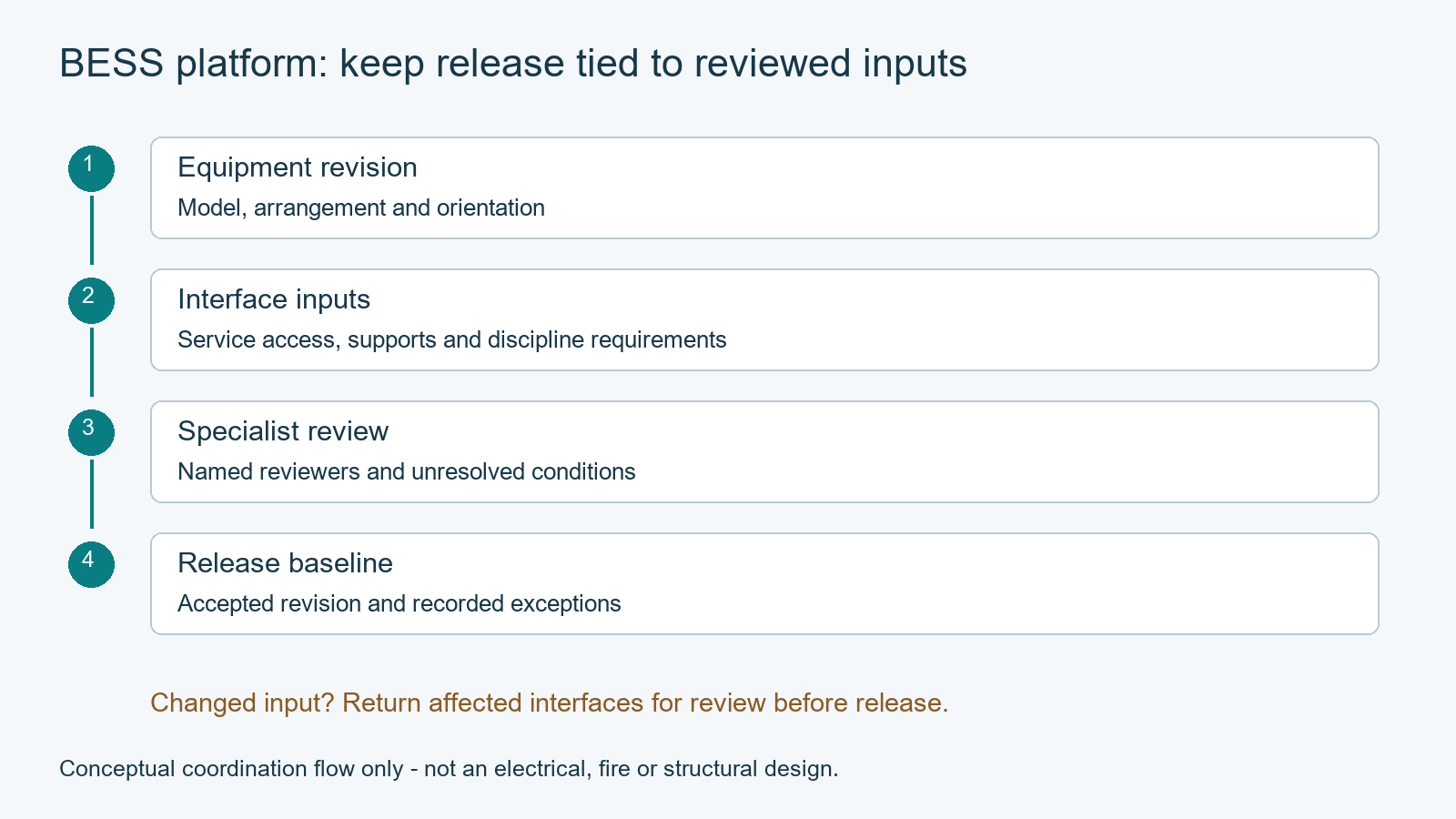
Use a record that ties an accepted input to a specific revision and reviewer. The following is an editorial coordination tool, not a design standard:
| Interface | Input to record | Acceptance owner to identify |
|---|---|---|
| Equipment identity | Model, arrangement revision and installed orientation | Equipment supplier and EPC |
| Service access | Door movement and task-specific access information | Equipment service representative |
| Electrical space | Applicable requirements and drawing constraints | Project electrical reviewer |
| Fire and emergency arrangements | Project restrictions affecting the platform | Assigned project specialists |
| Structure and foundations | Elevations, supports, loads and connection basis | Responsible structural/civil designers |
| Release and changes | Accepted revision, exceptions and notification route | EPC release authority |
Treat “frozen” as an identified release baseline. If an input changes, record the change and return affected interfaces for review. A revised enclosure model should not remain hidden behind an unchanged platform purchase-order description.
The MACHS platforms and walkways page provides a starting point for a drawing-based scope discussion. A general capability description does not establish suitability for a particular battery installation.
How does the founder's system perspective apply here?
Gavin Yang's published specification comment links product choice with the surrounding loads, materials, fabrication and installation decisions. Read his original comment.
Our editorial application to BESS procurement is to make interface ownership part of the enquiry: the platform layout should remain connected to the equipment revision and discipline reviews that justify it. This is an application of the general principle, not a claimed founder approval of BESS electrical or fire design. MACHS's knowledge base likewise calls for drawings, loads, connections, environment and responsibility boundaries in structural-system enquiries.
What do EPC buyers ask before requesting a quotation?
Can we request a budget price before interfaces are frozen?
Yes, request a quotation against explicitly stated preliminary inputs and assumptions. Keep the unresolved review conditions attached to the response and agree what is needed before fabrication release.
Does specifying FRP remove the need for electrical review?
No product label establishes the complete installation's electrical suitability. Submit the project requirements for assessment of the actual proposed configuration and interfaces.
What should the first enquiry include?
Send the current equipment arrangement, marked platform location and elevation, service-access information, support concept and outstanding discipline inputs through MACHS project enquiries. Request a clearly bounded response identifying what can be evaluated and which inputs remain open.
Related buyer FAQ · Review application conditions · More buying questions